
Retire early in India with this simple, story-driven guide. Learn 7 proven steps: set your FIRE number, save smart, invest right, and design a free life.
A cup of chai, a quiet decision
Riya and Karan used to joke that their lives were sponsored by meetings and traffic.
Most evenings ended the same way: a quiet dinner, a half-watched show, and two phones buzzing with tomorrow’s reminders. One Friday, sitting on their tiny Pune balcony with two cups of chai and a tired sunset, Riya said, “Imagine a Monday that doesn’t scare us.”
Karan grinned. “Imagine a Friday that doesn’t have to save us.”
That conversation didn’t end with a grand plan. It began with a gentle question: What if to retire early isn’t about quitting work, but about choosing life? They weren’t chasing luxury; they were chasing time—to read, to travel slow, to take care of parents, to volunteer, to work on projects they truly cared about.
This guide is written for people like them—and maybe you. It blends the math of FIRE (Financial Independence, Retire Early) with the soft human truths we don’t always say out loud: fear of family expectations, the tug of cultural duties, the guilt of saying no, and the quiet desire to live at our own speed. Think of it as a step-by-step playbook wrapped in simple language, everyday stories, and clear actions. The goal isn’t perfection; it’s freedom with dignity.

The heart of early retirement (and why it’s not escapism)
Retire early in India doesn’t mean you stop doing anything. It simply means your investments cover your expenses, so work becomes optional. You may still work—freelance, part-time, a passion project, a sabbatical year, a small business—but the paycheck no longer rules your choices.
If you grew up in India, money is rarely just numbers. It’s weddings and festivals, parents and children, duty and dreams—all woven together. So when we talk about how to retire early, it’s not a slogan. It’s a way to reclaim your schedule, your attention, and your peace.
A line to carry with you: “I’m not running away from work. I’m walking toward choice.”
Your North Star — the FIRE number

The simplest way to define financial independence is this:
Why ×30? Because India has higher inflation and thinner safety nets than places where the classic 25× rule (the “4% rule”) was popularised. With ×30, you build in a cushion for healthcare, education, family duties, and the unexpected.
If your household spends ₹10,00,000 a year, your FIRE number is ~₹3,00,00,000 (₹3 crore).
Three steps to find your number:
- Track 60 days of real expenses (no guesswork, no shame—just observe).
- Multiply your monthly average by 12 to get your current annual lifestyle cost.
- Multiply that by 30. Write this number on a sticky note. Put it where you’ll see it.
You’ll adjust this number over time (for inflation, goals, kids, location). For now, let it be your North Star—not a weight, but a direction.
Pro tip: Create two numbers:
- Lean FIRE: bare-bones needs (rent, groceries, utilities, basic insurance).
- Comfort FIRE: your “normal” life with modest travel, eating out, small joys.
Having both creates flexibility—you can switch modes in tough years without losing the plot.
Visual prompt: A simple progress bar graphic—“₹0 → Your Target Corpus”.
The three selves that keep you sane
Budgets often fail because they punish the present to feed the future. But you can’t starve your soul into freedom.
Use this simple lens:
- Past Me → Loans, responsibilities, promises.
- Present Me → Health, joy, tiny treats, small adventures.
- Future Me → Investments, safety, independence.
If Present Me gets nothing, you’ll rebel.
If Past Me dominates, you’ll feel stuck.
If Future Me rules everything, you’ll burn out.
Goal: Harmony, not perfection. Set your budget lines and tag each rupee to Past/Present/Future. If any “self” is starving, reallocate. You’re building a life, not a spreadsheet.
Think of your budget as a thali. If one dish is missing, the meal feels off. Balance is flavour.
Seven proven steps
Step 1: Find Your FIRE Number (clarity is kindness)
- FIRE number = yearly expenses × 30.
- Adjust for India-specific realities: parental healthcare, school/college fees, rent vs home loan, and your city’s cost of living.
- Write two versions: Lean and Comfort.
Riya and Karan did a “60-day truth audit.” They found quiet leaks: food delivery, cab rides, subscriptions. They didn’t slash everything; they trimmed with care. Their expenses dropped, their number stayed realistic, and—surprise—their home felt lighter.
Takeaway: Numbers feel cold, but this one number becomes a compass—every rupee you save points you closer to freedom.
Step 2: Save More Without Feeling Deprived
Your savings rate is the biggest lever on your timeline. Aim for 40–60% humanely—not by punishing joy, but by taming the big three:
- Home: Don’t over-EMI. Rent where it’s efficient. If buying, buy modest and early enough that it doesn’t choke cash flow.
- Transport: Metro/EV/used car > new-car EMIs. Walk more. Your body will thank you.
- Food: Weekly meal planning + home cooking + “restaurant but not routine.”
Tiny habits that compound:
- Auto-SIPs run the same day your salary lands.
- Half-raise rule: invest half of every raise or bonus before lifestyle expands.
- Cancel two barely used subscriptions and redirect to SIP.
- Create a “joy fund” (small but sacred). Present-Me deserves love too.
Riya switched from daily cabs to metro + walking. She saved ₹6,000/month. One choice cut years from their timeline.
Every rupee saved is a brick. Patiently stack them—one day you’ll realise you built a house called freedom.
Step 3: Clear High-Interest Debt Fast
Credit card balances and personal loans are wealth leaks. You can’t out-invest 24–36% APR.
- Use the avalanche method: pay off the highest interest first, while making minimums on the rest.
- Build a mini buffer (₹50k–₹1L) so an emergency doesn’t push you back into debt.
- Pause new gadgets and “reward purchases” till those balances die.
Why this matters emotionally:
Debt ties your today to your yesterday. Clearing it is a reset. Many people say the day they became debt-free felt like exhaling after holding their breath for years.
Every rupee of debt cleared is a rupee that can start compounding for you instead of against you.
Step 4: Invest Smart for Growth and Safety
Inflation in India isn’t gentle. Your plan needs growth to outrun it and stability to sleep well.
Illustrative mix (not advice; a simple frame to think with):
- 60% Equity → Broad index funds (Nifty 50/Nifty 500), flexi-cap; a small global slice if available and suitable.
- 25% Debt → PPF, EPF, high-quality debt funds, government/PSU bonds.
- 10% Income assets → REITs/dividend funds (know they can be volatile).
- 5% Cash buffer → Peace-of-mind money for surprises.
Tax-smart tools that help:
- ELSS (80C) for equity + tax deduction (3-year lock-in).
- PPF (80C) for guaranteed long-term base (15 years, extendable).
- NPS (80CCD(1B)) for an extra ₹50,000 deduction + retirement stream.
Mindset shift: Don’t invest for excitement. Invest for endurance. A portfolio that quietly compounds beats a portfolio that loudly performs and crashes.
Step 5: Build your “after-work” plan (so freedom lasts)
Retiring at 40–50 means funding decades. Think like a chess player: protect the king (your lifestyle), mobilise the board (your buckets), and stay patient.
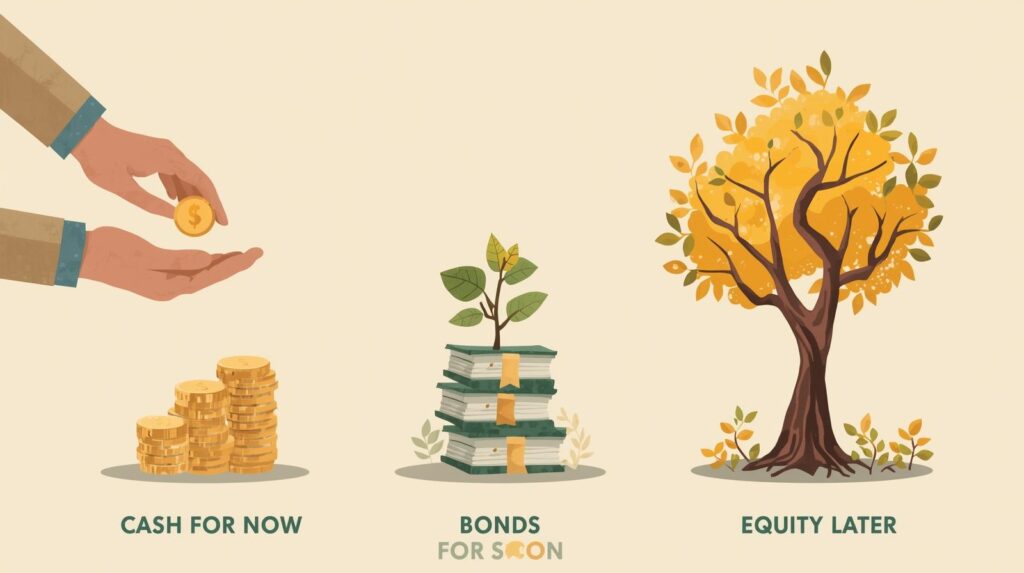
Three-bucket plan (super simple):
- 0–3 years of expenses → Liquid funds/FDs (touch any time).
- 3–10 years → Target-maturity debt funds (predictable).
- 10+ years → Equity index funds (long-term compounding).
Health + emergency:
- Buy comprehensive health insurance early (add a super top-up).
- Keep an emergency fund of 9–12 months of expenses (families lean toward 12).
Withdrawal rule of thumb in India: Start around 3.5–4% a year (adjust for inflation). Conservative first; loosen later if your corpus grows faster than expected.
The day your money pays your bills, your mind quiets down. You start hearing your own voice again.
Step 6: Review once a year (consistency > perfection)
Make it a ritual. Riya and Karan did “Money Sunday” every quarter: chai, 60 minutes, no drama.
- Check net worth (15 minutes).
- Rebalance toward target mix (sell some winners, top up laggards).
- Audit lifestyle creep (the sneaky little increases).
- Re-run Old vs New Tax Regime for the current year.
Think of it like dentist appointments for your money. Small, regular check-ups prevent big problems.
You don’t need perfection. You need consistency.
Step 7: Use the “step-up” magic (the quiet accelerator)
A 10–15% annual increase to your SIPs (aligned with appraisals) can shave years off your FI timeline.
Rohan started investing early with his parents’ guidance. At 22, when he got his first job, he doubled his SIP to ₹6,000 and committed to a 15% step-up each year. He didn’t feel poor—he just automated the upgrade before lifestyle could claim it. By his late 30s, his corpus crossed his ₹3.6 crore target (₹12 lakh annual spend × 30), and work became optional. The magic wasn’t secret picks; it was discipline + time.
Practical script for yourself:
“On appraisal day, I raise my investments first. Lifestyle can wait its turn.”
The pocket calculator you’ll actually use
- Years to FI ≈ Target Corpus ÷ Annual Investable Surplus
- Surplus needed = Target Corpus ÷ Years
Examples (rounded, to visualise):
- Target ₹3 crore in 20 years → ~₹15 lakh/year (₹1.25 lakh/month).
- Target ₹2 crore in 20 years → ~₹10 lakh/year (~₹83k/month).
Too steep today? Start smaller. Build side income. Use the step-up habit. Shift a couple of big costs. Revisit your city choice (geo-arbitrage within India is real—tier-2/3 cities often mean the same joy at half the price).
Simple Mantra : You don’t have to be fast. You have to be steady.
Real stories, real India
Priya — BaristaFIRE by 32
Priya began her software career in Bengaluru. While friends upgraded apartments and cars, she stayed simple and intentional. She saved nearly 60% of her ₹12-lakh salary, invested through SIPs, used ELSS and PPF for stability and tax benefits, and resisted lifestyle creep. By 32, she had ₹1.2 crore invested. She didn’t “retire”—she pivoted to BaristaFIRE: a part-time role she loved, with afternoons free for writing and travel. Her money worked, and so did she—on her terms.
Lesson: Early FI doesn’t mean no work. It means better work, at your pace.
Samir — discipline over income
A Delhi schoolteacher, Samir was never “high salary.” He tracked every rupee in a simple notebook, tutored in the evenings, and invested consistently in index funds. He avoided the status race. Over time, discipline did what high income often doesn’t—built stability, then momentum. His wealthier peers had shinier lives, but thinner safety nets. Samir slept better.
Lesson: Savings rate and consistency often outweigh income.
Arjun — semi-retirement via geo-arbitrage
Arjun, an engineer in Pune, set a ₹3 crore target. Instead of dreaming of a luxury flat, he explored Nashik—lower costs, slower life. With careful SIPs, NPS contributions, and no lifestyle creep, he worked toward semi-retirement. He didn’t escape work; he designed it around meaning. Geography was a tool, not a compromise.
Lesson: Your pin code can be your biggest hidden lever.
Kavya — CoastFIRE in a tier-2 city
By 28, after five intense years of saving 55% of her pay, Kavya switched to a passion job with less stress and less pay. Her earlier investments now compounded quietly. By 40, her portfolio outgrew her paycheck—that’s CoastFIRE. Freedom without drama. A life that breathes.
Lesson: Front-load effort, then coast while compounding does the heavy lifting.
Rohan — the parent-powered head start
At 15, Rohan’s parents opened a minor’s mutual fund account and started a ₹2,000/month SIP. Rohan added ₹500–₹700 from gifts and small savings. His father believed in India’s Banking & Financial Services story and chose a fund with strong long-term prospects (returns vary; discipline stays). By 22, Rohan had a base he didn’t waste—he doubled his SIP and stepped it up 15% each year. In his late 30s, he felt FIRE—not just on paper. The point isn’t the exact numbers; it’s the timeline shift created by early start + step-ups.
Lesson: Financial independence can start before your first salary—with guidance, tiny habits, and matching contributions.
Specific realities (plan for them, don’t fear them)
1) Inflation isn’t polite.
Plan with an assumption higher than the headline. Healthcare and education often rise faster. That’s why we prefer ×30 over ×25.
2) Social security is thin.
Buy term insurance early if others depend on your income. Get health insurance with a super top-up while premiums are still sane.
3) Cultural milestones matter.
Weddings, festivals, extended family help—these are beautiful parts of life. Budget them as separate goals so they don’t raid your FI corpus.
4) Markets are moody.
Near FI or post-FI, keep 24–30 months of expenses in low-volatility assets. This buffer lets you ignore a bad market year without panicking.
5) Parents’ care fund.
Create a Parents’ Care Fund equal to roughly 3 years of expected medical costs. Top it up yearly. It protects them and protects your plan.
The psychology that quietly decides everything
Money decisions rarely fail on spreadsheets; they fail in the heart.
- Identity shift: Don’t say, “I can’t spend.” Say, “I’m someone building freedom.”
- Automation beats willpower: Set it and forget it. Let systems make the hard choices.
- The 48-hour pause: For non-essentials, wait two days. Most impulses die.
- Community helps: Find a friend, partner, or group to share the journey.
- Define “enough”: If the goalpost keeps moving, so will your peace. Name your finish line (then protect it).
So many of us confuse riches with independence. Riches are loud; independence is quiet. Riches impress; independence heals. When your money buys time, you become the person you intended to be.
Your first 30 days (a gentle, doable plan)
Week 1 — See clearly
- Start a simple tracker (pen-and-paper works).
- Cancel two subscriptions.
- Write your “why”: If money stopped deciding my schedule, I would…
Week 2 — Build guardrails
- Open/align accounts (SIP, PPF, NPS as relevant).
- Set up one SIP (even ₹1,000).
- Create a mini emergency fund target (₹50k–₹1L to start).
Week 3 — Shift the big rocks
- Choose one Big-Three change (home, transport, or food).
- Implement the half-raise rule on salary day (or simulate it now).
- Tell someone you trust what you’re doing (accountability).
Week 4 — Future-proof
- Shortlist a health policy and super top-up; begin the process.
- Pick your Money Sunday date and add a calendar reminder.
- Write your FIRE number (Lean + Comfort). Place it where you’ll see it.
Promise to yourself:
“Small steps, done every week, beat big plans that never start.”
How to Handle Setbacks on the FIRE Journey
- Job loss: Cut to the Lean budget. Use your buffer. Turn on side-income ideas you kept aside for “someday.”
- Market crash: Don’t sell your future for today’s fear. That buffer (24–30 months) is your permission to wait.
- Family pressure: Share your one-page vision—what a good day looks like without money stress. Invite them into your why.
- Motivation dips: Revisit your Present-Me budget. Add a small joy back in. We persist when the present is respected.
A setback isn’t a verdict. It’s a plot twist. You’re still the author.
Work-Optional Life: What FIRE Really Feels Like
Many people who reach FI don’t actually stop working. They work lighter:
- Consultancy on projects they enjoy.
- Teaching, mentoring, volunteering.
- A café, a homestay, a craft studio.
- A sabbatical to care for parents or young children.
- Long, slow travel—without burning leave.
FI is not a finish line. It’s a threshold. On the other side, life feels more like choice than chase.
Common Myths About Early Retirement
“It’s only for high earners.”
Truth: Savings rate + time + behaviour beat income more often than you think.
“I must buy a house first.”
Truth: Not always. A heavy EMI can crush flexibility. Renting while investing can be smarter early; buying later, with options, can be wiser.
“The 4% rule is universal.”
Truth: In India, be conservative—3.5–4% with a 3-bucket plan.
“Starting late means game over.”
Truth: Start now. Raise your savings rate, step-up SIPs, trim the big three, add side income, give yourself a few extra years. Many 40-somethings get there.
“FIRE means never working.”
Truth: Most people choose meaningful work—just without the money anxiety.
A Simple Philosophy to Remember
One day, Karan said, “Money used to feel like weather—random and scary. Now it feels like a season we understand.”
Riya smiled. “We still have storms. But we built a house.”
That house wasn’t made of luck. It was made of auto-SIPs, fewer cab rides, home-cooked meals, honest talks with parents, two insurance policies, one emergency fund, and a hundred Money Sundays. It was made of choosing enough. It was made of listening to Present Me without betraying Future Me.
If you remember only one line from this entire guide, let it be this:
“Financial independence isn’t about owning more. It’s about needing less—and choosing wisely.”
The Step-Up Rule
Copy this, paste it into your notes, and read it every appraisal season:
“Before I increase my lifestyle, I increase my SIP by 10–15%.
Present-Me gets a small treat; Future-Me gets the raise.”
This one sentence can change timelines.
The 5-Minute FIRE Math Anyone Can Do
When someone asks, “How much do I need?” hand them this:
- Track one month without judging.
- Multiply by 12 → Annual spend.
- Multiply by 30 → FIRE number.
- Divide by Years left → Annual surplus needed.
- Divide by 12 → Monthly plan (then step-up 10–15% yearly).
Remind them: start small, start now, and automate.
The math is a compass. The habit is the journey.
Answers to Common FIRE Worries
What if markets crash right after I retire?
You’ll use your cash/debt bucket first. That’s why you saved 24–30 months of expenses. You’ll pause inflation raises for a year, maybe take up BaristaFIRE. You’ll ride the storm.
What if a medical event hits?
This is why you bought comprehensive health insurance and a super top-up. This is why you keep the emergency fund. You planned for it, before it happened.
What if family obligations increase?
You earmarked separate funds for weddings and parental care. You’ll adjust your timeline by a year or two if needed. Freedom is flexible.
What if I get bored?
You won’t. You’ll design your days. Learn, teach, build, rest, travel slow, start something small, mentor someone. Boredom is a blank page. You’ll write again.
Your Easy FIRE Checklist
- Track expenses for 60 days (no shame).
- Compute FIRE (Lean + Comfort) = annual spend × 30.
- Kill high-interest debt (avalanche), set mini buffer.
- Start one SIP (even ₹1,000).
- Add PPF/NPS/ELSS as suitable.
- Pick one Big-Three change (home/transport/food).
- Buy health insurance + super top-up; evaluate term insurance.
- Build 9–12 months emergency fund (over time).
- Create Parents’ Care Fund (3 years expected costs).
- Schedule Money Sundays (quarterly) + annual rebalance.
- Apply half-raise rule and 10–15% step-ups.
- Write a one-page family vision for a good day without money pressure.
- Revisit your city math (geo-arbitrage if helpful).
- Keep a small joy fund active—always.
A Glimpse of Life After FIRE
They wake without alarms.
Karan waters the balcony tulsi; Riya reads two chapters of a book that has waited years for her. They walk to a nearby café, not because it’s fancy, but because the owner now knows their names. An email arrives about a short consulting gig—three weeks, interesting work, fair pay. They accept, not for survival, but for curiosity.
This is what it looks like when you retire early—not quitting life, but living it on your own terms.
After lunch, they video-call their parents to plan a slow trip—two weeks in their hometown, not rushed. In the evening, they cook with friends, argue kindly about cricket, and share the last of the mango pickle. No one checks LinkedIn to count titles. They laugh more than usual. Time feels like theirs.
This is not a dream. It’s a design. A hundred small moves over a hundred quiet weeks. Compounding, not just of money, but of choices.
Your Next Step Toward Freedom
If money stopped deciding your schedule, what would your best Tuesday look like? Write it. Make it specific—people, places, smells, sounds.
Action (takes 5 minutes):
Open your app. Start one SIP (even ₹1,000).
Set a calendar reminder titled “Step-Up SIP by 10%” on your next appraisal month.
Close the app. Make chai. You’ve started.
Explore More
- The Psychology of Money: 18 Hidden Secrets of Financial Success
- Why Financial Independence Beats Riches in the Long Run : Think Beyond 2025
- The Hidden Power of Compounding: 7 Proven Lessons for a Better Life
- Wealth Habits That Last: 10 Smart Money Systems for Life
- Financial Independence Mistakes: 8 Mistakes Holding You Back From True Freedom
- What is the FIRE Movement in India: 7 Powerful Secrets to Financial Independence
- What is FIRE Movement: 7 Powerful Secrets to Achieve True Financial Freedom – Ultimate Global Guide
- How to Stick to a Budget Without Feeling Restricted: 7 Proven Strategies
- SEBI:Money Matters : Let’s Understand
FAQ
1) What does “retire early” really mean in India?
Your investments cover your expenses, so you work by choice. Most people keep some passion/part-time work.
2) How do I find my FIRE number?
Annual expenses × 30 (India-safe). ₹12 lakh/year → target ~₹3.6 crore.
3) Is the 4% rule valid in India?
Use 3.5–4% for safety. Pair with a 3-bucket plan.
4) Can middle-class families do this?
Yes. Save 40–60%, avoid lifestyle creep, choose low-cost cities if helpful, and keep SIPs steady.
5) Which investments are best to start?
Broad index funds for growth, PPF/EPF/NPS for stability/tax, REITs for income (with volatility).
6) Should I buy a house before FIRE?
Only if it doesn’t crush cash flow. Renting + investing often wins early in the journey.
7) How big should my emergency fund be?
9–12 months of expenses (families lean to 12).
8) How often should I review the plan?
Quarterly light check; annual rebalance + tax regime comparison.
9) What if I started late (35–45)?
Increase savings rate, step-up SIPs, trim big costs, add side income, push a few years—still very possible.
10) How do I avoid quitting mid-way?
Feed Present Me a little joy, keep Money Sundays, and celebrate small wins. Harmony beats perfection.