
Discover the FIRE Movement in India with 7 powerful secrets to achieve financial independence. Learn FIRE number, 4% rule, and inflation-proof strategies.
Introduction
If money stopped ruling your schedule, how would you truly spend your day?
That one simple, but powerful, question is at the heart of the FIRE Movement in India — Financial Independence, Retire Early.
FIRE is not about rejecting work. It is about reclaiming something deeper — your time, your choices, your dignity.
The idea began in the West, popularised by Vicki Robin and Joe Dominguez in Your Money or Your Life. Today, it has found new energy in Indian cities where rising incomes meet rising dreams.
Take Priya, a 32-year-old from Bengaluru. She started her career with a ₹12 lakh salary and a simple habit: save more than half of what she earned. SIPs, ELSS, and PPF became her tools. By the time her friends were just starting to think of buying cars, Priya had already built a corpus of over ₹1 crore. She didn’t “retire” — instead, she moved into BaristaFIRE, working part-time in a role she loves, while her investments silently take care of her future.
For someone else, like Arjun from Pune, FIRE means something different. He dreams of moving to Nashik, where living costs are half, and semi-retiring with a ₹3 crore target. His plan mixes SIPs, NPS, and geo-arbitrage — not to escape work, but to gain freedom.
This guide blends global FIRE principles with Indian realities — tax rules, cultural responsibilities, inflation, and healthcare — so you can craft a plan that is bold yet practical.
In truth, we are all like rivers, flowing towards the sea. Financial independence is not the end of the journey. It is the freedom to decide how the next bend in your river should look.
What the FIRE Movement Really Means
A simple breakdown of how Financial Independence, Retire Early actually works.
FIRE—Financial Independence, Retire Early—means building a portfolio whose passive income (dividends, interest, rental flows, planned withdrawals) covers your living expenses. When that happens, you no longer need a paycheck; you can work because you want to, not because you must.
Just as important: FIRE is math and mindset.
- The Math Side: Know your FIRE number, save aggressively, invest consistently, and use a prudent withdrawal rate.
- The Mindset Side: Live intentionally, avoid lifestyle creep, and define your personal “enough.”
Your FIRE Number and Withdrawal Rule: The Two Pillars of Independence
Your FIRE Number (Your Freedom Target)
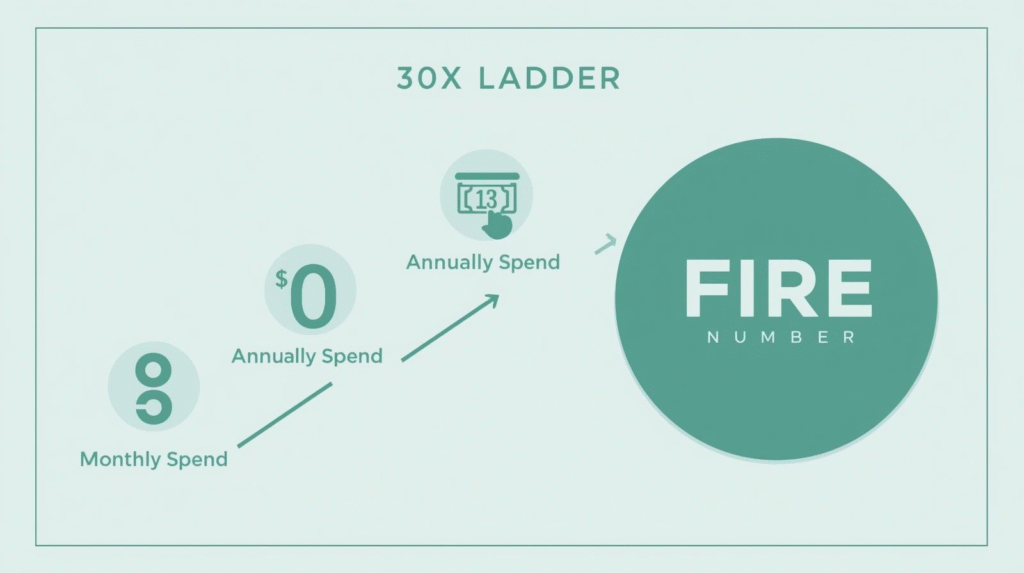
Your FIRE number is the corpus needed to fund your lifestyle indefinitely. Globally, a quick heuristic is 25× annual expenses; in India, where inflation (especially healthcare/education) can bite and the safety net is thinner, 30× is a safer starting point.
Example: Annual expenses ₹10 lakh → FIRE number ~ ₹3 crore (30×).
The Safe Withdrawal Rule (3.5%–4% guide)
The classic 4% rule says you can withdraw 4% of your portfolio annually (inflation-adjusted) from a diversified portfolio. In India, many opt for a 3.5–4% range for extra safety.
7 Proven Ways to Reach Financial Independence
Calculate Your FI Number — Add Local Buffers
Start with Annual Expenses × 25–30. Then add India-specific buckets:
- Parents’ healthcare and eldercare
- Children’s education/marriage
- One-off life choices (e.g., sabbatical, relocation, home upgrades)
Raghav (33, Pune) pegged FIRE at ₹2.2 cr on current expenses. After adding parents’ care, a child-education fund, and a sabbatical cushion, the real target rose to ₹2.9 cr—more honest, less fragile.
Save Aggressively – But Keep It Humane
Your savings rate is the timeline lever. Many FIRE followers aim for 50–70% when possible, but it must be humane and sustainable.
India-savvy trims (Big Three):
- Housing: Rent where efficient; avoid over-mortgaging.
- Transport: Prefer public transit/EVs/used cars; resist EMI traps.
- Food: Home cooking + weekly planning beats impulse dining.
Automation: Pay yourself first with auto-debit SIPs (growth) + monthly transfers to PPF/NPS (stability). Renegotiate OTT, internet, insurance yearly—small wins compound.
Frugal, Not Deprived – Live With Intention
Frugality isn’t punishment; it’s precision.
- Audit joy per rupee—keep what enriches you; cut what doesn’t.
- Consider geo-arbitrage: Tier-2/3 cities can halve costs without halving joy.
- Buy quality once; maintain and repair.
- Use India’s community resources—libraries, parks, maker spaces.
Mindset: Minimalism isn’t about having less; it’s about having room for what matters.
Start Early — Let Compounding Work for You
Time is the superpower. Even ₹5,000/month in an index fund from your early 20s can meaningfully snowball over decades.
Practical stack:
- SIPs in equity mutual funds for growth
- PPF/EPF for stability and discipline
- NPS for low-cost, long-term compounding
- Increase contributions with each appraisal
Diversify Smartly – Tools That Work Here
A resilient Indian FIRE portfolio balances growth, income, and safety:
- Equity: Broad-market index funds (core), diversified funds; small slice global
- Debt: PPF, EPF, quality debt funds, government/PSU bonds
- Income assets: REITs, dividend funds; consider fractional real estate with due diligence
- Safety nets: Term insurance + health insurance; emergency fund (9–12 months)
Illustrative mix (not advice): 60% equity, 25% debt, 10% income assets (REITs/dividend), 5% cash buffer.
Build Passive Income Streams Before You Need Them
Plant the income trees early:
- Dividends (expect variability)
- Bond coupons and laddered maturities
- REIT distributions or rental income
- Skill income (courses, consulting, content)
BaristaFIRE bonus: Keep part-time work after FI. It preserves health cover continuity, reduces withdrawal pressure, and keeps purpose alive.
Plan for Taxes & Inflation — Review Every Year
Two silent saboteurs: taxes and inflation.
- Old Tax Regime often wins during accumulation if you fully use 80C (PPF/ELSS/EPF), 80D (health insurance), 80CCD(1B) (NPS), HRA/Section 24 benefits.
- New Regime can suit low-deduction years, early career, or post-FIRE low income due to simpler slabs.
Plan for Drawdowns Like a Chess Player (Gap Enrichment woven-in):
Think in three tax buckets:
- Tax-free: PPF, cash buffer
- Tax-deferred: EPF, NPS
- Taxable: Equity, REITs, bonds
In retirement, withdraw from the bucket that keeps you in the lowest slab, harvest LTCG within annual limits, and use SWPs for predictability. Re-run both regimes every FY.
Unique Challenges—and Smart Ways to Handle Them
- Inflation and Rising Costs: Assume higher-than-headline inflation, especially in healthcare/education.
- Limited Social Security Nets: Buy term + health insurance early; premiums rise with age.
- Cultural Milestones and Duties: Weddings/festivals—budget separately; don’t raid your FI corpus.
- Dealing With Market Volatility: Keep 24–30 months of expenses in low-volatility assets pre-/post-FI.
Caring for Parents Without Breaking Your Plan (Gap Enrichment woven-in):
Create a Parents’ Care Fund equal to 3 years of expected medical costs; top up annually. Add a top-up health policy while premiums are affordable. This ring-fences parental care so your FI corpus stays intact.
Real Stories of FIRE
Priya’s Story — Bengaluru, BaristaFIRE
When Priya started her software career in Bengaluru, she watched friends upgrade to bigger apartments and shinier cars. She chose differently. By living simply and saving nearly 60% of her ₹12 lakh salary, she poured money into SIPs, ELSS, and PPF. By 32, her investments had grown to ₹1.2 crore. Today, she’s embraced BaristaFIRE, working part-time while enjoying afternoons of writing and travel. Priya is living proof that the FIRE Movement in India isn’t about deprivation—it’s about building freedom of choice.
Samir’s Story — Discipline Over Income
Samir, a schoolteacher in Delhi, never earned a high salary. Yet he quietly built momentum in the FIRE Movement in India by focusing on discipline over income. He tracked every rupee in a notebook, tutored evenings, and steadily invested in index funds. His progress was slow but steady, snowballing year after year. While many of his wealthier peers still juggle EMIs, Samir enjoys the peace of knowing he’s on track for independence—proving that in India, habits can outshine income.
Arjun’s Story — Semi-Retirement in Nashik
Arjun, a young engineer in Pune, has a crystal-clear goal: a ₹3 crore corpus, his personal FIRE number. He started SIPs early, contributes to NPS, and avoids lifestyle creep. His plan is not a luxury flat in Mumbai but semi-retirement in Nashik, where costs are lower and life is slower. For Arjun, the FIRE Movement in India isn’t about escaping work forever—it’s about designing a life around balance, not burnout.
Kavya’s Story — CoastFIRE in a Tier-2 City
Kavya, now 28, saved aggressively for five years, building a strong base by putting away 55% of her salary. Instead of chasing promotions, she switched to a passion-driven job with lower pay. Her portfolio now compounds quietly in the background. By 40, her investments will surpass her paycheck—classic CoastFIRE. Her journey reflects the FIRE Movement in India for young professionals: blending ambition with balance, without waiting for 60 to taste freedom.
Together, these stories highlight that the FIRE Movement in India isn’t reserved for the ultra-rich. It’s a mindset shift—about clarity, discipline, and defining what “enough” looks like in your own life
When Parents Plant the Seeds Early (Age 14–15)
Financial independence doesn’t only start when you get your first salary. It can start much earlier — even in student life — if parents give proper guidance. With the right planning, small sums in teenage years can turn into life-changing head starts.
Take the story of Rohan, a 15-year-old in Delhi. His parents opened a minor’s mutual fund account in his name (linked to their bank account) and committed to putting in ₹2,000 per month.
Rohan himself also began saving ₹500–700 every month. He set aside money from birthday gifts, Diwali envelopes, and even cut down on unnecessary spends like extra gadgets and online orders. Instead of letting that cash vanish, he asked his parents to divert it directly into the mutual fund SIP.
Rohan’s father strongly believed in India’s growth story. His view was simple: if India has to grow, its banking sector and blue-chip large-cap companies would grow even faster. So he chose a Banking & Financial Services mutual fund, which had delivered nearly 20% CAGR in the past 5 years.
Here’s what this meant for Rohan:
- With parents adding ₹2,000/month and Rohan contributing ₹500–700/month, the SIP became ₹2,500–2,700/month.
- Over 7 years (15 to 22), this meant just ₹2.5 lakh invested.
- At ~20% CAGR, this could grow to ₹7–8 lakh by age 22.
When Rohan got his first job immediately after graduation at 22, he carried these habits forward. Based on the same principles of budgeting and financial independence, he doubled his SIP to ₹5,000–6,000 per month. More importantly, he followed a step-up plan, increasing his SIP by 15% every year as his salary grew.
How This Changed His FIRE Path
- If he had stopped at 22: His early corpus of ~₹7–8 lakh could still grow into ~₹2–3 crore by 60 — decent, but not early independence.
- By doubling at 22: His corpus could grow to ~₹7–8 crore by 55–60.
- By increasing SIP 15% yearly from 22 onward: His investments snowballed quickly. By his late 30s, his portfolio had crossed his FIRE number (~₹3.6 crore, based on ₹12 lakh annual expenses).
In simple words: By starting with his parents’ guidance at 15, saving his own gifts, and then boosting and stepping up SIPs from age 22, Rohan achieved FIRE by 38–40.
At that stage, he wasn’t chasing paychecks — his investments could generate ₹10–12 lakh passive income every year, enough to cover family expenses. Work became optional, and financial stress was gone.
Practical Ways Parents Can Help at 14–15:
- Open a minor’s bank account + SIP in a trusted fund (parent as guardian).
- Match your child’s contribution — so they feel ownership.
- Redirect festival envelopes and birthday money into investments instead of one-time spends.
- Teach the power of step-up investing: increase SIP by 10–15% every year as income grows.
- Review performance once a year together — turning money into a family learning exercise.
Thumb Rule: Even ₹500 saved from gifts at 15, when invested early and then stepped up 15% yearly after the first salary at 22, can snowball into crores — bringing FIRE almost two decades earlier.
The Mindset Side of FIRE
Money is only half the equation. FIRE needs identity and family conversations.
- Handling Social Pressure
Expect “Why not a bigger house/car?” from relatives. Smile and stay the course. - Creating a Family Vision
Write a one-page family vision of “a good day without money pressure” and revisit it in tough seasons.
The Conversation That Changes Everything (Gap Enrichment woven-in):
Over one quiet dinner, ask: “What would we do if money didn’t decide it?” This page becomes your compass when social pressure peaks.
Common Myths About FIRE – And the Truth
| Myth | Reality |
|---|---|
| Only High Earners Can FIRE | Savings rate matters more than income. |
| FIRE Means Quitting Work Forever | Most do meaningful part-time on their terms. |
| PPF/ELSS/NPS Don’t Work Anymore | Still powerful for discipline & compounding. |
| You Must Buy a House First | Liquidity & flexibility may matter more. |
“But What If Markets Crash?” (Gap Enrichment woven-in):
Crashes test plans—they don’t break well-built ones. Keep 24–30 months in safe assets, consider BaristaFIRE as a pressure valve, and pause inflation adjustments for a year. Flexibility is your moat.
A Simple FIRE Calculator
Years to FI = Corpus ÷ Annual Surplus
- Corpus: ₹3 cr; Surplus: ₹12 lakh/yr → ~25 years
- Boost surplus to ₹18 lakh/yr → ~17 years
(Savings rate is your biggest lever; returns help, discipline decides.)
“Balance your money across three voices: Past (responsibilities), Present (joy), and Future (security). If one starves, life feels off-balance. If all three are heard, financial independence feels natural, not forced.”
Key Takeaways
- The FIRE Movement in India is math + meaning.
- Use 30× expenses and a 3.5–4% withdrawal guide.
- Save humanely but aggressively; automate SIPs; trim housing/transport/food.
- Diversify: equity + debt + income assets + insurance & emergency fund.
- Pre-fund parents’ care and cultural milestones—don’t tap your FI corpus.
- Re-plan tax regime annually; draw down via tax buckets.
- Consider Coast/BaristaFIRE to keep purpose and resilience.
Your Next Step Toward Financial Independence
If money stopped dictating your day tomorrow, what would you choose first—rest, art, seva, or a slower morning with your family?
Your Move Toward Change: Track 60 days of expenses, calculate your FIRE number (×30), and set up two SIPs this week—one growth (index fund), one stability (PPF/debt fund). Every rupee today buys you tomorrow’s freedom.
Explore More
- Wealth Habits That Last: 10 Smart Money Systems for Life
- The Ultimate Budgeting Guide: 5 Frameworks That Actually Work for Real Life
- Why Financial Independence Beats Riches in the Long Run : Think Beyond 2025
- Financial Independence Mistakes: 8 Mistakes Holding You Back From True Freedom
- The Psychology of Money: 18 Hidden Secrets of Financial Success
- The Hidden Power of Compounding: 7 Lessons for Life
- Emergency Expense Preparedness
FAQ
1. What is the FIRE Movement in India?
It’s a lifestyle and financial plan where you save and invest aggressively so that your passive income covers your living expenses, giving you the freedom to work by choice, not necessity.
2. How do I calculate my FIRE number?
Multiply your annual expenses × 25–30. In India, 30× is safer due to higher inflation and limited social safety nets.
3. Is the 4% rule reliable in India?
Yes, but with caution. A 3.5–4% withdrawal rate is safer in India because of inflation in healthcare, education, and daily costs.
4. Which tax regime supports FIRE better?
Usually, the Old Regime helps in the wealth-building phase (deductions for PPF, ELSS, NPS, insurance). The New Regime may be better post-FIRE, when income is lower and deductions don’t matter.
5. Can middle-class Indians realistically achieve FIRE?
Yes. With a 50–60% savings rate, disciplined SIPs, and smart location choices (geo-arbitrage), even average earners can target financial independence.
6. What is the difference between LeanFIRE, FatFIRE, and BaristaFIRE?
- LeanFIRE → Minimalist lifestyle with basic expenses only.
- FatFIRE → Comfortable or luxury lifestyle; requires a larger corpus.
- BaristaFIRE → Semi-retirement with part-time or passion work to reduce withdrawal pressure.
7. How much emergency fund do I need for FIRE in India?
Keep at least 6–12 months of expenses in a liquid account. Families or those with dependents should lean closer to 12 months.
8. What are the biggest risks to FIRE in India?
High inflation, unexpected medical costs, market crashes, and family obligations (like weddings or eldercare). Mitigation = insurance, buffers, and flexible spending.
9. Should I buy a home before going for FIRE?
Not always. While culturally important, a home can lock capital. Renting until FIRE, then buying with passive income, often gives better flexibility.
10. How often should I review my FIRE plan?
At least once a year (e.g., every Diwali or financial year-end). Recheck expenses, rebalance investments, and update your FIRE number for inflation and lifestyle changes.