
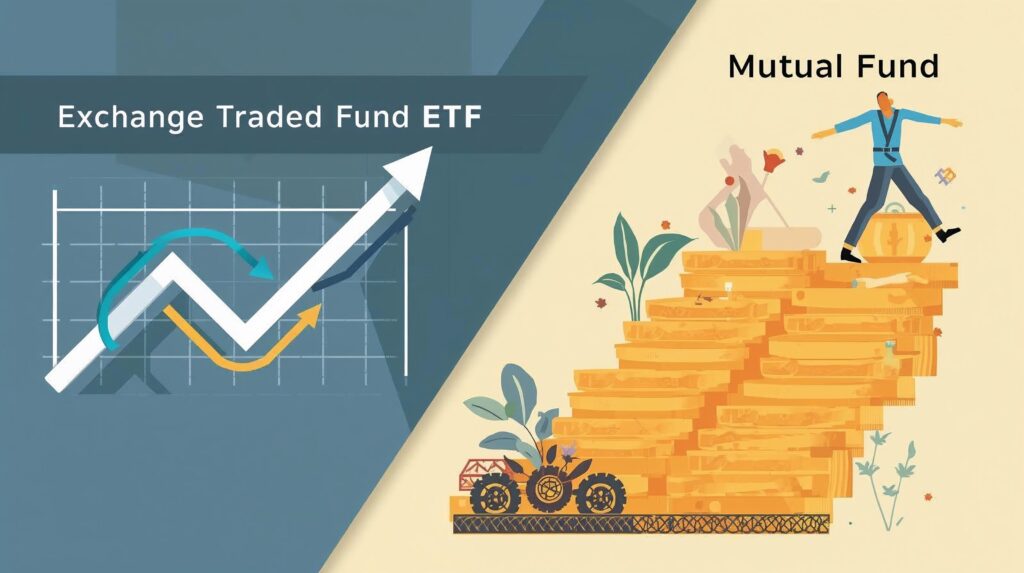
Learn the difference between ETFs and Mutual Funds, their costs, taxation, risks, pros and cons, and which suits investors best.
Introduction
Two friends start their investment journeys at the same time. One sets up a monthly SIP in a Mutual Fund, while the other buys an ETF on the stock exchange. A year later, both have invested in the same index, yet their experiences feel very different. This is the story of millions of investors worldwide. ETFs (Exchange Traded Funds) and Mutual Funds are two of the most popular investment vehicles. Both help investors diversify, save, and grow wealth. But their structure, accessibility, and psychology create a unique experience for each investor. Let’s break down the key differences, benefits, and future outlook for ETFs and Mutual Funds in a way that’s practical, simple, and future-ready.
What Are ETFs and Mutual Funds?
An ETF is like a basket of securities that you can buy and sell on a stock exchange, just like an individual stock. Most ETFs track an index, such as the Nifty 50 or S&P 500, and they are passive in nature, designed to mirror the performance of a benchmark.
A Mutual Fund pools money from many investors and invests it in securities. A professional fund manager decides what to buy and sell, and the price of a Mutual Fund, called the Net Asset Value (NAV), is calculated once a day.
NAV and AUM Explained
NAV (Net Asset Value): The per-unit value of a fund, updated daily.
AUM (Assets Under Management): The total market value of all assets held by the fund.
Index Funds and Relation to ETFs
An index fund is a type of Mutual Fund or ETF that replicates a market index such as Nifty 50 or S&P 500. Index ETFs trade on stock exchanges intraday, while index Mutual Funds are priced only once daily at NAV.
Structure and Working
Mutual Funds are managed by fund managers who make buy and sell decisions. They can be open-ended (allowing continuous investment and redemption) or closed-ended (locked in for a fixed period).
ETFs are generally passively managed, tracking an index. Investors buy and sell them through brokers on stock exchanges at market prices, which may slightly differ from NAV.
The expense ratio is the annual fee funds charge for managing money. Even a 0.5% difference compounds significantly over long periods. ETFs usually have very low expense ratios (0.1–0.5%), while actively managed Mutual Funds can charge 1–2%.
Costs and Fees
ETFs: Low expense ratios but involve brokerage charges, bid-ask spreads, and Securities Transaction Tax (STT). Frequent trading increases costs.
Mutual Funds: Higher expense ratios, especially in active funds. They may also charge exit loads if redeemed before a certain period.
Example: An ETF may charge only 0.2% annual expense, but every trade attracts brokerage. A Mutual Fund SIP may charge 1.5% annually but avoids brokerage.
Tax Implications
Taxation plays a big role in choosing between ETFs and Mutual Funds.
Equity Funds (ETFs and Mutual Funds)
Short-Term Capital Gains (STCG): If units are sold within 12 months, gains are taxed at 15%.
Long-Term Capital Gains (LTCG): If units are held for more than 12 months, gains above ₹1,00,000 are taxed at 10%.
Debt Funds (ETFs and Mutual Funds)
Gains are taxed as per the investor’s income slab. Indexation benefit for LTCG is no longer available (after 2023).
Example 1: Short-Term Holding
Investment: ₹2,00,000 → Sold after 6 months for ₹2,40,000.
Gain: ₹40,000
Tax: 15% of ₹40,000 = ₹6,000
Other charges: Brokerage + STT ~₹500
Net gain: ₹33,500
If the same was in a Mutual Fund, an exit load (say 1%) could further reduce returns to ₹32,000.
Example 2: Long-Term Holding
Investment: ₹2,00,000 → Sold after 2 years for ₹3,00,000.
Gain: ₹1,00,000
Tax: Nil (since LTCG up to ₹1,00,000 is exempt)
Net gain: ₹1,00,000 (minus ~₹500 charges in ETFs)
If the gain was ₹1,50,000 in a Mutual Fund, ₹50,000 would be taxed at 10% = ₹5,000.
ETFs are generally more tax-efficient because they avoid interim taxable events caused by fund manager trades inside Mutual Funds.
Performance and Risk
Mutual Funds: Depend on the fund manager’s skill. A good manager can outperform benchmarks, but poor management may lead to underperformance.
ETFs: Have no manager risk but may face tracking error — a slight difference between the ETF’s returns and its benchmark index.
Market volatility impacts both, while rising interest rates hurt debt funds more. Benchmarks like Nifty 50 or S&P 500 are used to compare performance.
Flexibility and Liquidity
ETFs: Bought and sold anytime during market hours like shares. Prices are transparent and update in real time. Best for active investors.
Mutual Funds: Bought or redeemed only once daily at NAV. Best for long-term disciplined investors using SIPs.
Investment Suitability
Mutual Funds: Best for beginners, salaried individuals, and long-term investors who prefer hands-off investing. SIPs encourage discipline.
ETFs: Best for cost-conscious, market-aware investors who want flexibility and control.
A balanced portfolio may use both — Mutual Funds for long-term SIPs and ETFs for tactical opportunities.
Practical Scenarios
Investing ₹5,000 per month: Mutual Fund SIP is easier and automated. ETFs require manual buying through a broker.
Intraday trading: Only ETFs allow intraday buying and selling.
If a fund shuts down: Mutual Fund investors receive redemption at NAV. ETF investors get liquidation proceeds.
The Future of ETFs vs Mutual Funds
Globally, ETFs are growing faster than Mutual Funds as passive investing gains popularity. In India, Mutual Funds dominate because SIP culture is strong, but ETFs are gaining traction among younger investors who value transparency and control.
Future trends may include tokenized ETFs, AI-driven fund management, and hybrid models that blur the line between passive and active investing. The shift is clear: trust is moving from human fund managers to transparent, rules-based systems.
FAQ
- What is the main difference between ETFs and Mutual Funds?
ETFs trade on stock exchanges like shares, while Mutual Funds are priced once daily at NAV. - Which has lower costs?
ETFs usually have lower expense ratios but carry brokerage and spread costs. Mutual Funds charge higher fees but no brokerage. - Are ETFs more tax-efficient than Mutual Funds?
Yes. ETFs usually create fewer taxable events, making them more tax-efficient than active Mutual Funds. - Can you do SIP in ETFs?
Some brokers allow SIP-like investing in ETFs, but it’s smoother with Mutual Funds. - Which is better for beginners?
Mutual Funds are usually better for beginners due to SIP discipline and professional management. - What is tracking error in ETFs?
It is the difference between an ETF’s returns and its benchmark index. - How are dividends taxed?
Dividends from both ETFs and Mutual Funds are added to your income and taxed at your slab rate. - Which is more liquid: ETFs or Mutual Funds?
ETFs are liquid intraday, while Mutual Funds allow daily liquidity at NAV. - Can Mutual Funds outperform ETFs?
Yes, actively managed Mutual Funds can outperform, though consistency is uncertain. - Will ETFs replace Mutual Funds in the future?
Unlikely. ETFs are growing, but Mutual Funds will remain strong due to SIP culture and ease for retail investors.
Key Takeaways
ETFs are low-cost, flexible, and transparent. Mutual Funds are simple, disciplined, and beginner-friendly. Both serve different needs, and many investors may benefit from combining them. The future belongs to a balance of passive efficiency and active strategy.
Explore More
- The Psychology of Money: 18 Hidden Secrets of Financial Success
- Why Financial Independence Beats Riches in the Long Run : Think Beyond 2025
- The Hidden Power of Compounding: 7 Proven Lessons for a Better Life
- Wealth Habits That Last: 10 Smart Money Systems for Life
- Financial Independence Mistakes: 8 Mistakes Holding You Back From True Freedom
- What is the FIRE Movement in India: 7 Powerful Secrets to Financial Independence
- What is FIRE Movement: 7 Powerful Secrets to Achieve True Financial Freedom – Ultimate Global Guide
- How to Stick to a Budget Without Feeling Restricted: 7 Proven Strategies
- SEBI:Money Matters : Let’s Understand
The choice between ETFs and Mutual Funds is less about which is “better” and more about which fits your investing style. Do you prefer discipline without daily involvement? Mutual Funds may suit you. Do you value flexibility and low costs? ETFs could be the answer. The wisest investors often blend both, using each tool where it shines. Investing, after all, is not about choosing sides — it’s about building resilience for the future you want.